ARTICLES
Dear Ugandan Hip-Hop Purists.

By Byaruhanga Felix (@TheNinjaFelix)
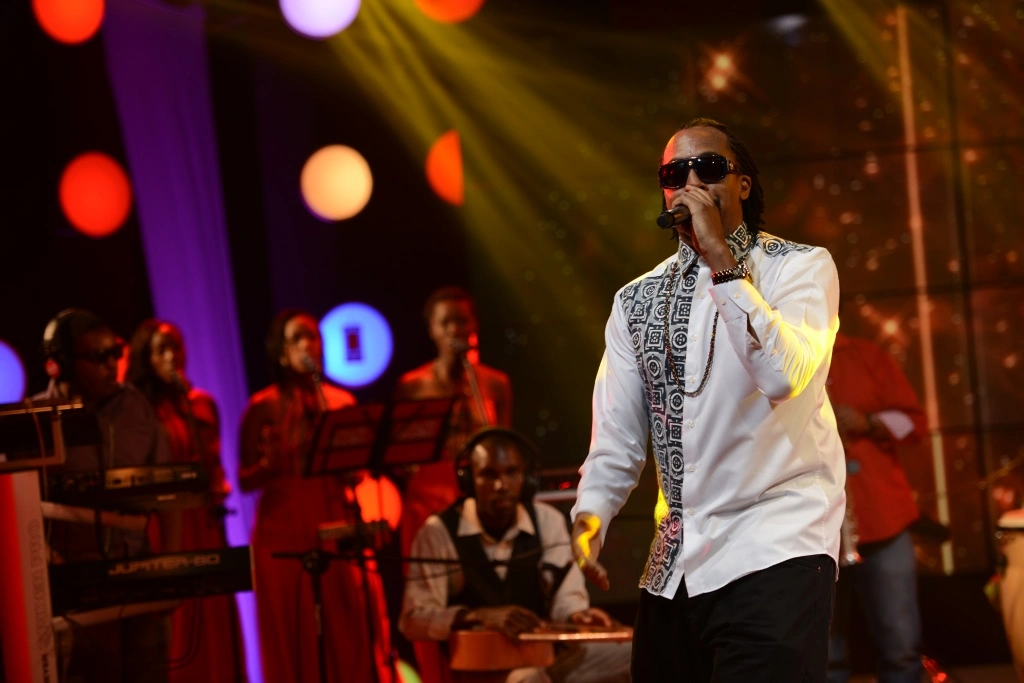
Last week Navio released “Embukuuli” and it got mixed reviews from the fans. The hip-hop heads were disappointed, even one of the Rap TV shows regarded to it as a “discouragement”. Personally I don’t share the same views; I actually tell people we should embrace such a track. The problem with us hip-hop heads, we’re so caught up in what’s hip-hop and what’s not you may think we’re in the Bronx where it all started. We forget we stay in Uganda. What does this mean for us? This means we need to add elements to UG hip-hop that a person from Owino will understand connect with and eventually become a dedicated fan of the genre. Some of Navio’s tracks that clearly show this. This will mean we’ve to celebrate tracks like Njogereza, Nawuliranga where he samples Frida Sonko, Kigozi (Iko Hivi) where he samples Fred Kigozi and his latest Embukuuli which is on a dancehall beat of which the genre happens to be one of the biggest in Uganda. Proof to that is Ziza Bafana’s recent concert or look at most of the artists flown into the country, most of them are dancehall artists. In brief he fuses two genres on tracks like Embukuuli.
Rappers like Sylvester & Abramz, Klear Kut, GNL, Babaluku have created an ecosystem that has enabled the hip-hop genre to thrive and proof to this are the diverse hip-hop acts we have accompanied with hip-hop platforms like The Tribe UG and others. So this means the objectives/goals as to why they are rapping differ. In the process of continuing to pursue their rap careers, hip-hop has broken down barriers, raised the bar of the entertainment industry in certain cases. A rapper like Navio has shown us it’s possible to rap your way to the corporate’s boardroom get an endorsement and the next day you’re at a refugee camp supporting people. So when he drops a track like “One & Only” let’s celebrate its achievements like being playlisted on BBC’s 1Xtra instead of complaining that it’s so commercial. One thing I always say is that people who complain time and again that Navio is so commercial are the people who don’t buy/listen to his albums. These are people who wait for promotional singles that are released online or tracks that are being played on TV then pass judgment on what’s hip-hop and what’s not.
One thing that we Africans especially Ugandans love is to party & dance. No one is going to dance to your 16 talking about how we are suffering in Africa; no girl is going to “twerk” on your bars on a hip-hop beat where you’re rapping your ass off. But they’re going to upload videos where they’re dancing to Njogereza, a track where Navio drops two or four bars. Don’t get me wrong, I’m all for conscious hip-hop or music in general that carries a message, but let’s not box in our artist and limit their creativity. This translates to performances too. You’ll see Navio being announced on the line-up of performers at “embuutu ye mbutikizi” and at the most raw hip-hop show or battle. This simply means that he knows how to cater for his fans and the Ugandan music market at large. A clear example of this is early this year when they released the official first Klear Kut single “let it rain” on a Saturday and later the following Monday Njogereza was out. These were tracks that had Navio on but catering for different listeners and markets so there’s nothing like there are too many Navio verses out. Let’s stretch it a bit and take it to the continental level. We’ve seen AKA release two albums and on the second one he realized he needs to connect more with the South Africans thus sampling tracks from Brenda Fassie which led to your favorite 2015 African hit “All Eyes on Me”. He keeps doing this on most of his successful singles but then turn around drop a single like “Dreamwork” for his hardcore hip-hop head fans. But you don’t see them refer to one of his tracks as a “discouragement” when he sings on a track with Diamond Platinumz. Look at Caracara that you enjoy by K.O which has elements of Kwaito (the South African version of Kidandali). They continue to find ways of adding their elements to South African rap and it works for them cause right now hip-hop is one of the most popular genres in S.A which wasn’t ten years ago and continues to dominate continental airwaves. But when one of our own does it, no he’s not hip-hop instead of celebrating it being the number one East African song on a purely West African TV station.
Hip-Hop is a foreign genre that we need to keep explaining to our people from time to time so that they can connect with it, in the process we get new fans thus the genre growing and become a genre that corporates can finance. Through this we can have more hip-hop artists grace concerts. So when Navio does Embukuuli instead of referring to it as a dancehall song let’s forward it to people who enjoy Ugandan dancehall so that they can run with it and in the process become new fans who in return will enjoy Enygma’s punchlines or Pryce Teeba’s side Zeno. Let’s figure out how to push rap to the masses instead of pretending to be New Yorkers in the ‘80s wearing oversized jeans, tees, timberlands standing on a corner of our social media streets discussing what’s hip-hop and what’s not. With that said download Embukuuli here












Last weekend we got our visas stamped as we took a trip into the B’raka Land. After a Euro-tour through Denmark, Finland and others… All the way to a sold out show in London, the fastest rising star on the African continent came back home to Kampala to deliver an epic concert on 29th November 2025, one day after dropping his debut album, JUVIE.
In one weekend, Joshua gave us so much to unpack. So, let’s start from the Music.
We have seen Joshua evolve from projects like Baby Steps, where songs like Tewekweka exposed some of us to his talent, all the way to Watershed, which let people know and confirm that he was for real. We journeyed with him through his Growing Pains, where the continental appeal was beginning to ring true, and then he gave us Recess. Through these many projects and countless features, Joshua has showed us his talent, consistency and heavy work ethic. It was constantly Moves on Moves until we finally got JUVIE.

Right from One of One, we knew we were in for some flames, and we did not have to wait to get them because the next song on the album, Morocco, delivered all the heat and then some. The song is a Banger, and from early reviews and reactions on the socials, it is clearly a crowd favorite. Joshua immediately follows this up with Dive In, which was released earlier as a single, so we already knew that JAE5 and Joshua Baraka had given us an anthem. The project does not slow down at all, as he continues into Still Young, another early crowd favorite, which confirmed that we were four for four with eight to go!
One of the things that made the listening process epic was the sequencing. After starting with all that heat, Joshua gives us a mini interlude, before slowing down the tempo with one of my favorite songs on the Album, This Time. It is a well written song with silky melodies and smooth vocals that will definitely appeal to the fans that are into his more afro RnB side.
Joshua kept the energy going with State of My Heart, which features Kenyan sensation, Bien, which he followed it up with Wrong Places, which spent most of 2025 as the number one song on Apple Music in Uganda and was by far the most streamed song on Spotify in Uganda this year.
Joshua Baraka’s Juvie makes for a nice, smooth and simple listening session, right from the start, all the way to the final song, So Low, featuring The Compozers, which was a perfect way to close the project and leave us on a high note.

By the time we got to Ndere Cultural Center for the concert, we were pumped and ready to get right to it. Those of us who knew all his projects and collaborations were eager to see what selection of songs he had picked to sing to us. Those of us who have watched him perform multiple times in the past were eager to witness his growth on stage and to be a part of yet another chapter of his story. Overall, there was a high dose of FOMO in the air. Before Joshua even sang, the show had already hit a number of positives in my books; great price structure from the early bird to the last day – This was perfect to allow the core fans to access and afford their night out with their superstar.
Another win for me was the strategic partnerships, from Talent Africa to Bell Citrus and Mirinda– this set up the perfect vibe and energy, making the drinks and food affordable, enabling every fan to have a total blast in this economy, especially with DecemBAR loading and Kampala about to throw event after event our way. By the time Joshua jumped on stage, the crowd was fully charged and ready to go! Shout out to Joshua and his team for ticking all the boxes.
The performance was great, overall. Joshua had great song selection, and did not leave us feeling as if we’d missed out on anything. He catered to the different fan groups that were present, from the day ones to the late comers. He even delivered some extra throwback fire for the older fans too. He picked the right collaborations in A Pass, IzabelUG, BigTril, Mun G and Maurice Kirya. We were not left wanting. And for any little thing that didn’t go according to plan, I just got more excited, because it just showed that there is still room to grow, and we can only trust that he will step right in and through that room.
Keep streaming JUVIE Here
By Byaruhanga Felix (@MrByaruhanga)
Oftentimes, you read reports indicating that the creative and cultural industry is one of the fastest-growing sectors on the African continent, expanding faster than oil & gas, mining, or many traditional industries. The backdrop of such reports is made up of institutions like Nafasi Art Space: a vibrant, innovative hub for artistic exchange in Dar es Salaam.
In a nutshell, Nafasi Art Space is a home for all creatives, from visual artists, performing artists, artisans, filmmakers, poets, musicians, to fashion designers. As a first-time visitor, I immediately felt that one of the things Nafasi derives its power from is embedded right in its identity, the name “Nafasi,” a Swahili word meaning “space” or “opportunity.” On that foundation, the leadership has created a home overflowing with possibilities, a place to create, learn, inspire, and provoke conversation in society, just as true art and artists do.
This home is not only a safe space for artistic expression, but beautifully inclusive. They continue to achieve this through outstanding programs such as the Nafasi Academy, Film Club, exhibitions, residencies, digital art lab, performing arts showcases, and more.
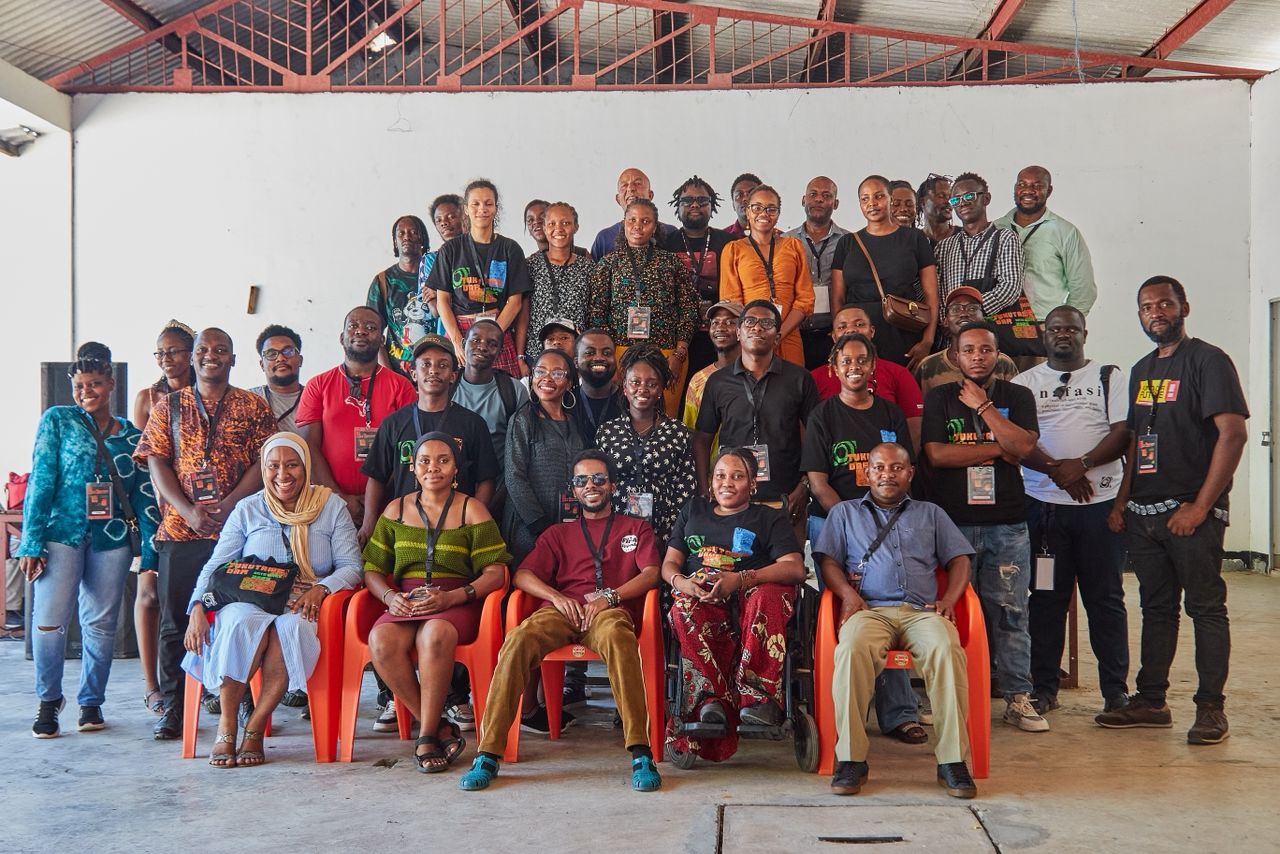
As November came to a close, Nafasi Art Space, in partnership with the Embassy of Switzerland in Tanzania and the Norwegian Embassy Dar es Salaam, hosted the 3rd edition of Tukutane Dar Arts Week under the theme: “Cross-Border Collaboration: For the CCI Sector Growth.” Tukutane was initially postponed for everyone’s safety due to post-election chaos, but with new dates confirmed (24th–30th November), more than 20 delegates from Africa and Europe converged at Nafasi to share knowledge, strengthen networks, and collaborate for a fruitful week of learning and cultural exchange.
One thing that hits you the moment you arrive at Nafasi is the energy and passion of the team behind the institution. From Fatma Mkota (Partnerships Coordinator) who welcomed and toured us around, to Gwendoline Charlotte (Marketing Manager) enthusiastically declaring, “I am here for content!”; Peter Lukumayi (Finance Manager) wearing multiple hats to ensure smooth operations; and of course Lilian Hipolyte (Director), the guiding force behind this dynamic ecosystem. Engaging with them makes it clear why Nafasi works: why the space feels like a sanctuary for creatives of every age, experience level, physical ability, gender, and discipline. This team of “Avengers” carried us throughout the week with a program that clearly took months of meticulous planning and resilience despite challenges.
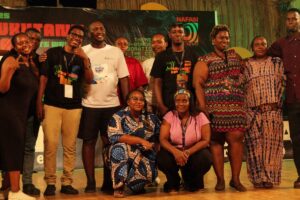
Alongside this remarkable team was an equally impressive group of delegates, passionate creatives ready to contribute from their wealth of experience. Through workshops, roundtables, and hands-on sessions, we exchanged practical ideas and explored possibilities for breakthroughs across the sector.
The exhibitions highlighted milestone achievements from Nafasi programs, showing where they started, where they are now, and what the future holds. We celebrated the progress of the Film Club residency cohort, the curators graduating from the Nafasi Academy in partnership with the University of Dar es Salaam, and talented artists showcasing their evolution. The evenings were spiced with curated showcases, cooling down the Dar heat while heating up vibrant dialogue, from panels on building communities in film and fashion, to a delicious Swahili food experience.
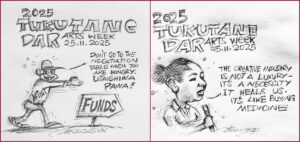
These were spaces created by artists for artists, and the audience engagement made that clear. Views were shared openly, disagreements turned into progressive debate, and ideas translated into art in real-time. Some of these memorable expressions were immortalized through live graphic commentary by Nathan Mpangala (cartoonist & illustrator), now proudly featured on Nafasi’s social pages.
As Tukutane Dar wrapped up, we were treated to a powerful closing event where over 80 artists took the stage, a testament to Nafasi’s impact in nurturing and amplifying talent. Performances included legendary Tanzanian acts and rising stars alike, while artisans showcased and sold work crafted during their time in the Nafasi community. It was a clear demonstration of a thriving alumni ecosystem, one that continues to enrich the creative economy long beyond a residency or program.
From start to finish, Tukutane Dar Arts Week 2025 was a reflection of what happens when space meets opportunity, when creativity meets community, when collaboration crosses borders.
I return home inspired, hopeful, and eager to contribute to the continued growth of our continental creative ecosystems.
Looking forward to celebrating the successes of Tukutane Dar 2025, again, in 2027.
ARTICLES
Apply Now: Koola Kampala Business Incubation Programme for Creative Entrepreneurs in Uganda.

If you’re a cultural or creative entrepreneur in Kampala looking to take your business to the next level, here’s a game-changing opportunity worth paying attention to. Africalia, in partnership with The Bold Woman Fund, has launched a new business incubation programme dubbed Koola Kampala, designed specifically to support and elevate Kampala’s creative and cultural sector.
Koola Kampala is a 12-month business support programme for legally registered creative businesses that are already generating revenue. It aims to build stronger, more sustainable enterprises by equipping entrepreneurs with the tools, mentorship, and strategic guidance they need to thrive in Uganda’s rapidly growing creative economy. Whether you’re running a music label, fashion brand, media studio, design outfit, or cultural enterprise, this programme is tailored to strengthen the business side of your creativity.
This initiative is funded by Africalia and aligns with the 2005 UNESCO Convention on the Protection and Promotion of the Diversity of Cultural Expressions, the Sustainable Development Goals, and national cultural development policies. It seeks to invest in the people driving Uganda’s creative heartbeat, young innovators building impactful businesses at the intersection of culture, identity, and entrepreneurship.
To be eligible, you must be over the age of 18, based in Kampala, and running a legally registered cultural or creative business that has been active for at least one year. Your business must already be generating revenue and able to provide samples of work when requested. More importantly, applicants should demonstrate a strong motivation to strengthen their business management and growth strategies.

The programme is structured in four key phases. First is the selection phase, during which 15–20 promising businesses will be shortlisted based on eligibility, motivation, and programme fit. This is followed by a 3-month pre-incubation phase, where selected participants will undergo a diagnostic assessment of their businesses, receive both group and individual coaching, and be trained on key business fundamentals. At the end of this phase, 12 businesses will be selected to move forward into the main incubation phase, which spans 9 months of intensive training, weekly one-on-one coaching, strategic growth support, and specialised modules tailored to the needs of each participant.
Once the incubation phase concludes, the programme enters its final phase—post-incubation—where participants will walk away with a tailored action plan for their business, deeper entrepreneurial skills, refined business models, and access to both national and international expert support. Additionally, they will have the opportunity to apply for seed funding to support the implementation of their business plans.
Applications are now open and will close on Saturday, July 5, 2025, at 6 PM (Kampala time). Interested entrepreneurs can apply through the online form available here. For further questions, Africalia and The Bold Woman Fund can be reached via africalia@africalia.be or contact@boldinafrica.com up until June 29.
For Kampala’s creatives, this isn’t just another programme—it’s a doorway to long-term growth, sustainability, and impact. If you’re ready to build a business that lasts and contributes meaningfully to Uganda’s creative ecosystem, Koola Kampala is the opportunity you’ve been waiting for.


REVIEW: Sincerely AfriKane The EP

INTO THE B’RAKA LAND

Tukutane Dar 2025: How Nafasi Art Space is Powering Africa’s Creative Economy

Apply Now: Koola Kampala Business Incubation Programme for Creative Entrepreneurs in Uganda.

Mitch Isabirye on Poetry, Collaboration, and Culture: The Story Behind ‘Poetry in Motion EP’

Maritza on Breaking Continental Barriers with Spoken Word EP ‘Poetry in Motion’

Kohen Jaycee’s ‘Gundeze’: A Soulful Anthem of Love.

On the Move by Denesi: A Powerful Anthem of Hustle and Ambition

Reviving Nostalgia: Akeine and Henry Tigan’s “Out of Control” Remix.

KJ Spio, Harmonize & Konshens Unite for ‘Messi

WATCH: The Tribe UG On Urban Today.

Elevate Your Music Career: Join AUMEX’s Essential Branding and Marketing Masterclass

REVIEW: Kaboo ft. Tai Dai & Soundlykbb – Thursday

Afro B Unleashes Cross-Continental Vibes in New Single & Video ‘Wo Wo Wo (Ebony)’

VIDEO REVIEW: Navio – Mad.

REVIEW: “Heart Strings” EP by Kohen Jaycee x Axon

Brian Babu and Regalia Apparel Launch Unisex ‘Uwili’ Capsule Collection

Angell Mutoni Drops Bold New Single “Kare” Ahead of Debut Album

REVIEW: “Prolific” EP by MooTowNoh
KJ Spio, Harmonize & Konshens Unite for ‘Messi
REVIEW: Kaboo ft. Tai Dai & Soundlykbb – Thursday
VIDEO REVIEW: Navio – Mad.

VIDEO: Afrie – Balongo (Live)

VIDEO: Nkomyewo – Bana Mutibwa

The Tribe UG: Press Play | Break – The Homie
REVIEW: “Heart Strings” EP by Kohen Jaycee x Axon
REVIEW: “Prolific” EP by MooTowNoh

The Tribe UG: Press Play | Wake ft. Mal-X, Tucker HD, and Flex D’Paper – FLEX

The Tribe UG: PRESS PLAY | Pound Or Shilling