ARTICLES
Tukutane Dar 2025: How Nafasi Art Space is Powering Africa’s Creative Economy

By Byaruhanga Felix (@MrByaruhanga)
Oftentimes, you read reports indicating that the creative and cultural industry is one of the fastest-growing sectors on the African continent, expanding faster than oil & gas, mining, or many traditional industries. The backdrop of such reports is made up of institutions like Nafasi Art Space: a vibrant, innovative hub for artistic exchange in Dar es Salaam.
In a nutshell, Nafasi Art Space is a home for all creatives, from visual artists, performing artists, artisans, filmmakers, poets, musicians, to fashion designers. As a first-time visitor, I immediately felt that one of the things Nafasi derives its power from is embedded right in its identity, the name “Nafasi,” a Swahili word meaning “space” or “opportunity.” On that foundation, the leadership has created a home overflowing with possibilities, a place to create, learn, inspire, and provoke conversation in society, just as true art and artists do.
This home is not only a safe space for artistic expression, but beautifully inclusive. They continue to achieve this through outstanding programs such as the Nafasi Academy, Film Club, exhibitions, residencies, digital art lab, performing arts showcases, and more.
As November came to a close, Nafasi Art Space, in partnership with the Embassy of Switzerland in Tanzania and the Norwegian Embassy Dar es Salaam, hosted the 3rd edition of Tukutane Dar Arts Week under the theme: “Cross-Border Collaboration: For the CCI Sector Growth.” Tukutane was initially postponed for everyone’s safety due to post-election chaos, but with new dates confirmed (24th–30th November), more than 20 delegates from Africa and Europe converged at Nafasi to share knowledge, strengthen networks, and collaborate for a fruitful week of learning and cultural exchange.
One thing that hits you the moment you arrive at Nafasi is the energy and passion of the team behind the institution. From Fatma Mkota (Partnerships Coordinator) who welcomed and toured us around, to Gwendoline Charlotte (Marketing Manager) enthusiastically declaring, “I am here for content!”; Peter Lukumayi (Finance Manager) wearing multiple hats to ensure smooth operations; and of course Lilian Hipolyte (Director), the guiding force behind this dynamic ecosystem. Engaging with them makes it clear why Nafasi works: why the space feels like a sanctuary for creatives of every age, experience level, physical ability, gender, and discipline. This team of “Avengers” carried us throughout the week with a program that clearly took months of meticulous planning and resilience despite challenges.
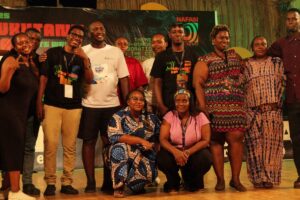

Alongside this remarkable team was an equally impressive group of delegates, passionate creatives ready to contribute from their wealth of experience. Through workshops, roundtables, and hands-on sessions, we exchanged practical ideas and explored possibilities for breakthroughs across the sector.
The exhibitions highlighted milestone achievements from Nafasi programs, showing where they started, where they are now, and what the future holds. We celebrated the progress of the Film Club residency cohort, the curators graduating from the Nafasi Academy in partnership with the University of Dar es Salaam, and talented artists showcasing their evolution. The evenings were spiced with curated showcases, cooling down the Dar heat while heating up vibrant dialogue, from panels on building communities in film and fashion, to a delicious Swahili food experience.
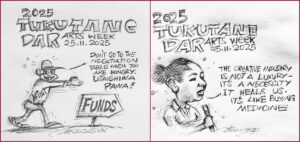
These were spaces created by artists for artists, and the audience engagement made that clear. Views were shared openly, disagreements turned into progressive debate, and ideas translated into art in real-time. Some of these memorable expressions were immortalized through live graphic commentary by Nathan Mpangala (cartoonist & illustrator), now proudly featured on Nafasi’s social pages.

As Tukutane Dar wrapped up, we were treated to a powerful closing event where over 80 artists took the stage, a testament to Nafasi’s impact in nurturing and amplifying talent. Performances included legendary Tanzanian acts and rising stars alike, while artisans showcased and sold work crafted during their time in the Nafasi community. It was a clear demonstration of a thriving alumni ecosystem, one that continues to enrich the creative economy long beyond a residency or program.
From start to finish, Tukutane Dar Arts Week 2025 was a reflection of what happens when space meets opportunity, when creativity meets community, when collaboration crosses borders.
I return home inspired, hopeful, and eager to contribute to the continued growth of our continental creative ecosystems.
Looking forward to celebrating the successes of Tukutane Dar 2025, again, in 2027.